
PSLV-C60 was launched on 30 December 2024, carrying the SpaDeX satellites (SDX-01 and SDX-02). Both were successfully injected into a 470 km circular orbit at an inclination of 55°.
Docking: 16 January 2025
Undocking: 13 March 2025 at ~09:20 IST
SpaDex Docking
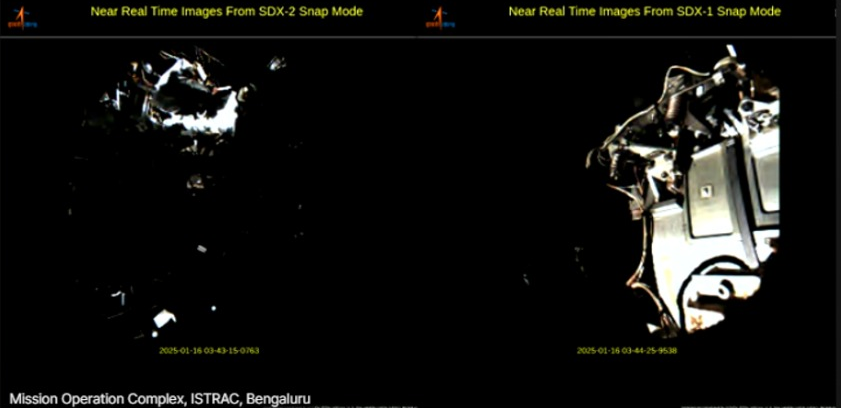
Image/Video Courtesy: Indian Space Research Organisation (ISRO)
SpaDex Undocking

Image/Video Courtesy: Indian Space Research Organisation (ISRO)
SpaDex Undocking
The undocking activity of the SpaDeX satellites was successfully carried out in a 460 km circular orbit with a 45-degree inclination, achieving success on the very first attempt. Following the separation, both satellites are now orbiting independently, with their health confirmed to be normal. Extensive analysis of the in-orbit performance during the docked phase identified an optimal opportunity for undocking between March 10 and March 25, 2025. The entire operation was meticulously monitored through ground stations in Bengaluru, Lucknow, and Mauritius, ensuring precise execution. With the satellites now operating separately, further experiments are planned in the coming days, advancing key mission objectives and validating crucial space technologies for future ISRO missions. – ISRO
SpaDeX Docking Timeline
- 07/01/2025 – Docking attempt aborted. Further validation required through ground simulations due to an identified abort scenario.
- 09/01/2025 – Docking attempt aborted. During a maneuver to bring the satellites within 225 meters, unexpected drift was observed post non-visibility period. The planned docking was postponed. Both satellites remained safe.
- 12/01/2025 – A trial attempt was conducted, successfully reaching 15 meters and then 3 meters. The spacecraft were then moved back to a safe distance for further analysis.
- 13/01/2025 – At 09:46 UTC, the estimated distance between the satellites was 3.3 km.
- 16/01/2025 – Successful docking achieved!
The maneuver from 15 meters to the 3-meter hold point was completed.
Docking was initiated with precision, leading to successful spacecraft capture.
Retraction and rigidization were carried out smoothly, ensuring stability.
Payload health was reported as normal.
Post-docking, the two satellites were successfully controlled as a single unit. - 18/01/2025 – Satellites’ health confirmed as normal.
- 13/03/2025 – Successful undocking at ~09:20 IST. However, the inter-satellite power transfer objective remains to be demonstrated.
Objectives of the SpaDeX Mission
The SpaDeX mission is designed to develop and demonstrate key technologies for rendezvous, docking, and undocking between two small spacecraft – SDX01 (Chaser) and SDX02 (Target) – in low-Earth orbit.
- Power Transfer Demonstration: Testing the ability to transfer electrical power between the docked spacecraft, a crucial capability for future in-space
- Composite Spacecraft Control: Evaluating how the two spacecraft function as a single unit when docked.
- Post-Undocking Payload Operations: Assessing the performance and operations of payloads after separation.
New Technologies in the SpaDeX Mission
The SpaDeX mission incorporates several indigenously developed technologies to enable autonomous rendezvous and docking. These include:
- Advanced Docking Mechanism – A precision-engineered system for secure spacecraft docking.
- Rendezvous and Docking Sensor Suite – A set of four specialized sensors to aid in approach, alignment, and docking.
- Power Transfer Technology – Enables the transfer of electrical power between docked spacecraft, a critical feature for future in-space servicing.
- Autonomous Rendezvous and Docking Strategy – A novel, self-reliant system designed for efficient and safe docking without human intervention.
- Inter-Satellite Communication Link (ISL) – Facilitates direct communication between spacecraft, incorporating built-in intelligence to track each other’s state.
- GNSS-Based Relative Orbit Determination and Propagation (RODP) Processor – Determines the relative position and velocity of the counterpart spacecraft using satellite navigation data.
- Simulation Test Beds – Hardware and software environments for rigorous validation and testing of mission systems before deploymen
These technologies are crucial for future autonomous space missions, on-orbit servicing, and in-space assembly, enhancing India’s capabilities in space robotics and satellite operations
SpaDex Images
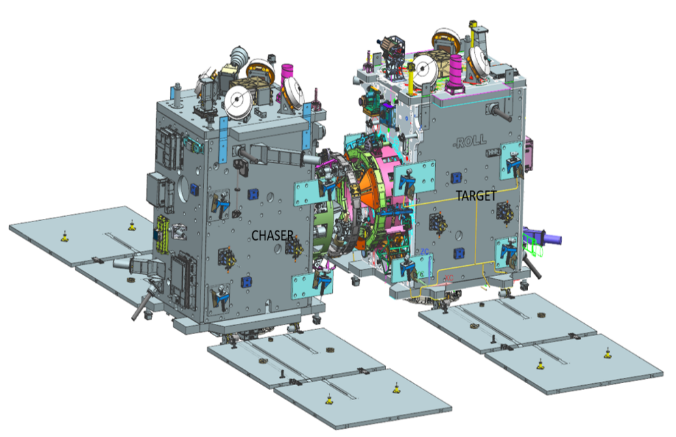
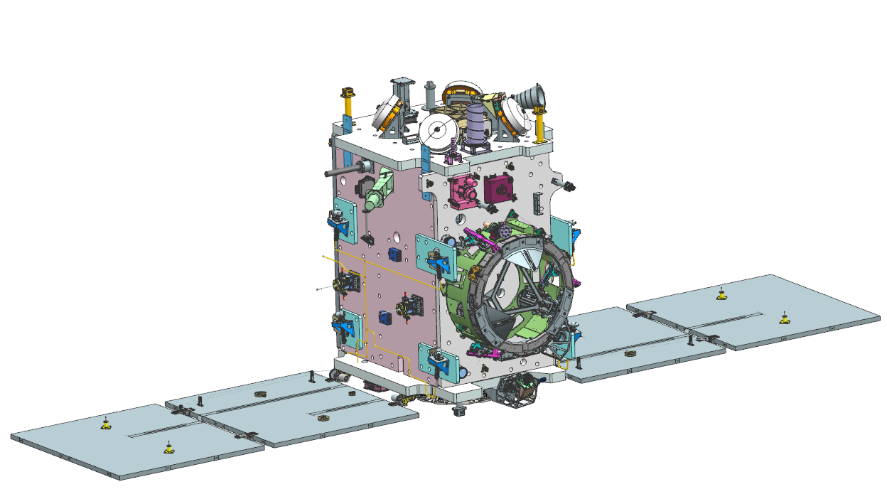
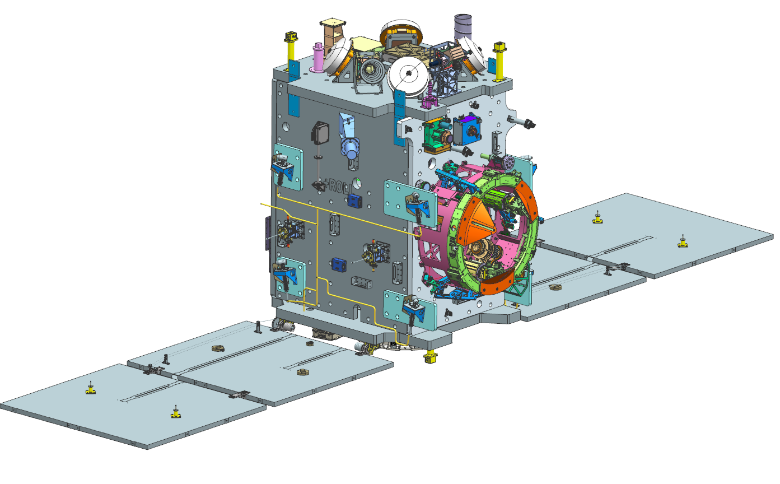
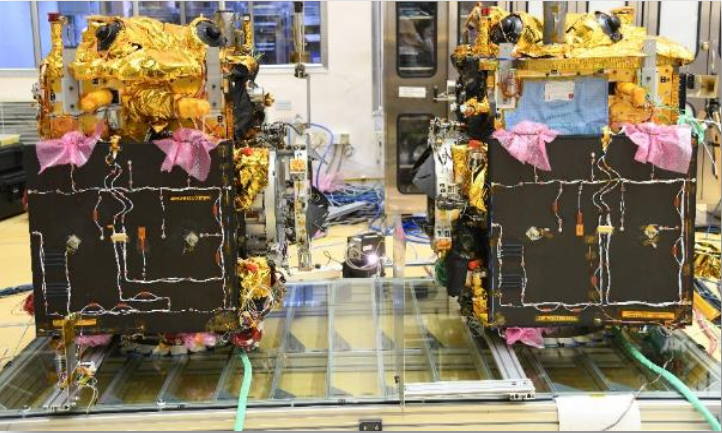
Image Courtesy: Indian Space Research Organisation (ISRO)
The SpaDeX mission marks a significant milestone in India’s space capabilities, laying the groundwork for future ISRO missions, including the Chandrayaan-4 Sample Return Mission, the Bharatiya Antariksha Station, and other advanced space operations. The successful demonstration of autonomous rendezvous, docking, and undocking is a critical step toward enabling on-orbit servicing, in-space assembly, and human spaceflight support.
For Chandrayaan-4, which aims to bring lunar samples back to Earth, precise docking technology is essential for the orbiter and ascent module to transfer samples mid-space. The Bharatiya Antariksha Station, India’s planned space station, will require similar rendezvous and docking mechanisms for docking visiting spacecraft, crewed missions, and cargo modules. Additionally, future ISRO missions, such as satellite servicing, in-space refueling, and formation flying missions, will greatly benefit from the inter-satellite communication, power transfer, and relative navigation technologies tested in SpaDeX.
By demonstrating these capabilities, SpaDeX strengthens India’s position in space technology and enhances its ability to execute complex deep-space, lunar, and orbital missions in the coming decades.
Disclaimer: The images, videos, and information used in this blog are sourced from ISRO’s official mission pages and press releases. All rights are owned by the Indian Space Research Organisation (ISRO). This content is shared for educational and informational purposes only.
Source: https://www.isro.gov.in/
More Info.: https://tanmaytalekar.in/blog/file/spadex-mission/


