Introduction to SpaDeX
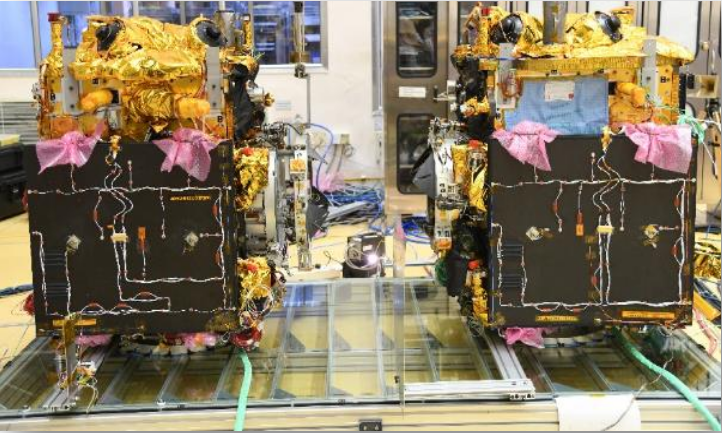
The SpaDeX mission (Space Docking Experiment) by ISRO marks a historic step in India’s space journey. Designed as a cost-effective technology demonstrator, SpaDeX showcases India’s capability in performing autonomous in-orbit rendezvous, docking, and undocking of two small satellites.
This mission is more than a technology test—it directly supports India’s long-term goals such as lunar sample-return missions, deep-space logistics, and the construction of the Bharatiya Antariksh Station (BAS).
Objectives of SpaDeX Mission
The primary goal of SpaDeX is to validate India’s ability to:
-
Perform autonomous docking and undocking of spacecraft.
-
Demonstrate electrical power transfer between docked satellites.
-
Test coordinated control of combined spacecraft during docking.
-
Conduct payload operations post-separation.
These milestones are crucial for future space station modules and interplanetary exploration.
Mission Design and Execution
-
Launch Vehicle: PSLV-C60
-
Satellites: SDX01 (Chaser) and SDX02 (Target) – each ~220 kg
-
Orbit: Circular orbit at ~470 km altitude
The Chaser gradually approaches the Target through a sequence of maneuvers — from 20 km down to just a few meters — using advanced navigation and docking algorithms. After docking, power transfer is tested, followed by undocking and independent payload operations.
Indigenous Technologies in SpaDeX
ISRO developed several homegrown innovations for SpaDeX:
-
Low-impact androgynous docking mechanism
-
Laser range finders and rendezvous sensors for precision navigation
-
GNSS-based Relative Orbit Determination and Propagation (RODP) system
-
Inter-satellite communication links for real-time coordination
-
Advanced guidance algorithms like Glideslope and PV guidance
These technologies will support Chandrayaan-4 and other deep-space missions where autonomous docking is essential.
Docking Hardware & Sensor Suite
The docking system is compact yet powerful, featuring:
-
Laser and video-based sensors for different approach stages
-
Mechanical entry sensors for docking confirmation
-
Compact actuators with reduced footprint but high reliability
This multi-layered sensor suite ensures accuracy across distances ranging from kilometers to centimeters.
Post-Docking Payloads
After docking and separation, both satellites conduct scientific operations:
-
SDX01: High-resolution Earth observation camera
-
SDX02: Multispectral imager for resource monitoring
-
Radiation monitoring experiments for future human spaceflight safety
Development & Launch Preparation
-
Designed and developed at UR Rao Satellite Centre (URSC)
-
Integration support by Ananth Technologies, Bengaluru
-
Final testing and launch prep at SDSC-SHAR
Conclusion – India’s Future in Space Docking
The SpaDeX mission positions India among the few nations with autonomous docking capability. Beyond a demo, it is a foundation for:
-
Modular space station assembly
-
Lunar and Mars missions
-
Future deep-space logistics
With SpaDeX, India takes a decisive step toward self-reliance in advanced space operations.
Official Page: https://www.isro.gov.in/mission_SpaDeX.html
Linked Post: https://www.isro.gov.in/mission_SpaDeX.html